The Nozzle That Ate My 0402s: Bore Size Was the Number I Ignored

The first sign was a 0402 that came back from the bottom camera sitting at an angle.
I was halfway through a 20-board batch of a small sensor board: nine 0402 decoupling caps, a dozen 0603s, two SOIC-8s. The machine is a Vertex 4, running OpenPnP. It ships with a 503 and a 505, and the 503 went into N1 for the small end of the BOM, which is the reasonable reading of those two nozzles if you have not thought about it much. I had not thought about it much.
The first four placements were clean. Then a cap was picked, photographed, and reported with an offset OpenPnP could not correct, so the job skipped the placement. Two picks later it stopped with "no part on nozzle". A third one turned up in the tape with an empty pocket where the part should have been.
By board three I had three missing caps, one sitting on its side, and a nozzle that would not pick anything at all. That last part is what made me stop blaming the feeder. A pick that fails on one part is a feeder problem. A pick that fails on every part after it is a nozzle problem, whatever the nozzle looks like from the outside.
Where I looked first, and why none of it was it
An hour went into the tape path. I re-indexed the feeder twice, checked the sprocket, checked the tape tension, and then loaded a second feeder with the same reel to rule the first one out. The failure followed the nozzle, not the feeder. That was the clue, and I should have taken it seriously sooner.
Then the usual vacuum checks. Fingertip over the tip, vacuum on, and I felt almost nothing. On a good nozzle there is a definite pull; on this one there was a weak hiss and no grip. So the tip came off the spindle.
With a loupe and a light behind it, the bore looked closed. I ran a 0.3 mm cleaning wire in and a 0402 came out, wedged at an angle just inside the face with its long side across the bore. It had been sitting in there for most of a board, and every pick after it had been trying to pull through a blocked aperture.
The dimension I had been reading wrong
Nozzle charts give two numbers per nozzle, and I had been watching the wrong one. The outer dimension is the tip face, the part that touches the chip. The inner number is the bore, and the bore is the hole the chip has to stay out of.
| Nozzle | Tip outer | Bore | Juki's component width range |
|---|---|---|---|
| 502 | 0.7 mm | 0.4 mm | 0.45 mm ≤ D < 0.75 mm |
| 503 | 1.0 mm | 0.6 mm | 0.75 mm ≤ D < 1.45 mm |
| 504 | 1.5 mm | 1.0 mm | 1.1 mm ≤ D < 2.5 mm |
| 505 | 3.5 mm | 1.7 mm | 2.5 mm ≤ D < 4.0 mm |
A 0402 chip is 1.0 × 0.5 mm. The narrow dimension decides the nozzle, because 0.5 mm is the number that has to stay wider than the hole.
Against a 503, the chip is 0.1 mm narrower than the 0.6 mm bore. There is clearance, and vacuum will use it. Against a 502, the same chip is 0.1 mm wider than the 0.4 mm bore, so it cannot start into the tip at all. Same part, same pump, same pressure. One nozzle holds the chip on the face, the other lets it travel.

That is the failure I spent a morning chasing. The 503 is a good nozzle with a wide range of work: 0603 and 0805 chips, SOT23, SOD323, small tantalums, all of which it picks without complaint. For a 0402 it is one step too wide, and 0.1 mm of clearance is all the vacuum needs.
What the machine tells you, and when
OpenPnP can confirm a pick through the vacuum line, and on this platform the vacuum range belongs to the nozzle tip rather than to the machine. Opulo's calibration docs walk through it: read the vacuum value with the tip open, read it again with a part held on the tip, and set the range between the two. Each tip reads differently, so a range copied from another nozzle number is wrong.
Two consequences of that, and both hit me on the same board.
A chip that has started into the bore still covers most of the opening. The vacuum reading can land inside the range, part detection passes, and the real symptom shows up two steps later as a vision offset, which reads like a camera or calibration problem. If you are chasing that instead, start with bottom camera exposure rather than the nozzle.
Vacuum part detection can also be switched off. OpenPnP supports it, and it is a reasonable choice because the bottom camera photographs the part before placing anyway. On a machine set up that way there is no early warning at all: the job runs, placements drift, and the first hard symptom is a nozzle that has stopped picking.
Confirming it before you take the head apart
This is the order I use now, and it would have saved me that first hour.
- Take the nozzle off the spindle and hold it up with a light behind it. A blocked bore shows as a dark centre instead of a bright opening.
- Compare the reel against the placement count. A pocket that is empty when the part was not placed means the chip went somewhere.
- Run a 0.3 mm cleaning wire through the bore. It fits a 502 and a 503. Anything that comes out gets looked at under magnification before it goes in the bin.
- Refit the nozzle, pick the same part ten times in a row, and watch the bottom camera image on each pick. A chip that is settling, rotating, or half inside the tip is visible in that image.
- Only then start swapping feeders.
Nothing on the machine reports a part lodged in a bore. There is no sensor in the tip and no error code for it. What you get is a run of strange, unrelated-looking failures that share one cause.
What I run now
The Vertex 4 is rated from 0402 and up. That rating assumes a 502, because 0402 is the 502's row in Juki's component table, and the machine's two shipped nozzles start one step above it. A stock head covers most boards comfortably and struggles with the smallest part the machine claims to place, which is a gap worth knowing about before your first fine-pitch job rather than during it.
Current setup on my bench: 502 in N1 for anything 0402 and below, 503 in N2 for 0603, 0805 and SOT23, 504 for 1206 and small tantalums. The Juki-compatible nozzle set covers 502 through 507 in one purchase if you would rather have the range on the shelf than reorder it. The 502-to-507 nozzle set is the one I keep as spares at $69 for six tips, and the nozzle assembly at $49 is the drop-in unit with holder, connecting rod, pneumatic fitting and stepper motor, for when the head rather than the tip has failed.
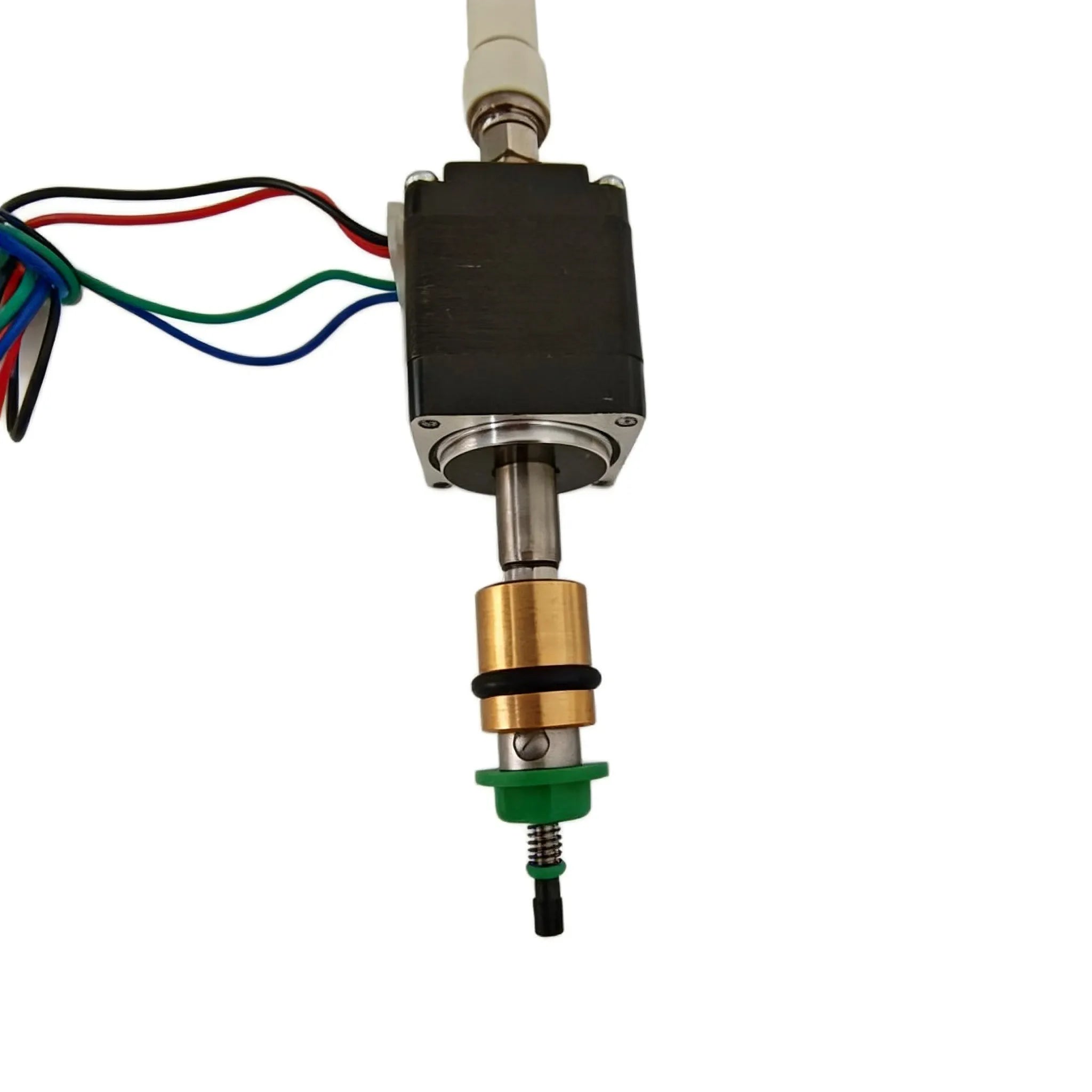
Every nozzle number has a different tip length, so a swap moves your pick height and leaves the vacuum range set for the old tip. Re-run nozzle tip calibration and the calibration that goes with a swap before starting a job. The first time I changed a nozzle I skipped that step and spent an evening moving a pick height in 0.05 mm increments, which is a much slower way to learn the same thing.
Before the next run, open the BOM, find the smallest narrow dimension on it, and compare that number with the bore of the nozzle in the spindle. If the part is narrower than the hole, order the right tip. Two minutes of arithmetic against an afternoon of picking wedged chips out of a nozzle, which is the trade I made this time.
Small parts and nozzle choice come up constantly with these machines, so the nozzle reference pages and the feeder overview are where the rest of the detail lives.